

Is your manufacturing business relying on a single bank loan while competitors access more strategic and cost-effective financing structures? In Cumberland County, where manufacturing employs more than 10,000 workers and generates $5.1 billion in total output, that question carries significant weight, as the answer can affect your chances of growth and stability.
Capital stacking is one financial structure that can support a manufacturer’s success. Made of various layers of funding, a capital stack can be used to finance manufacturing expansions and operations. Understanding how to coordinate private bank loans, public programs, and specialized capital sources determines whether your expansion project reaches its full potential or stalls before completion.
Capital Stacking vs. Single-Bank Loans
The single-bank-loan approach creates limitations that many manufacturers don’t recognize until they’re midway through an expansion project. Relying on one lender overexposes that institution to your project risk, which often results in lower loan amounts, higher interest rates, or more restrictive terms. This approach also caps your total project capacity at whatever that single lender is willing to commit, leaving no room to scale if opportunities emerge.
Layered financing for manufacturers takes a different approach. This financing strategy coordinates sources and uses across four needs, matching repayment terms to the asset’s life.
Equipment
The first need is equipment. Sized to the machinery’s useful life, equipment loans are typically paid back over 7-10 years. A term that’s too short creates payments the business can’t comfortably support, while a term that’s too long can leave debt outstanding on equipment that’s already been replaced.
Working Capital
The second need is working capital, which can be divided into two categories: seasonal and permanent. Since seasonal needs fluctuate, inventory builds ahead of large orders, and receivables accumulate before customers pay. A revolving line of credit is designed for this pattern. The business draws on the line as the need arises and repays it as cash is collected.
Permanent
Permanent needs don’t fluctuate, and every manufacturer carries a baseline level of inventory and outstanding receivables throughout the year. Because that baseline is ongoing, financing it on a line of credit places a permanent need under an agreement that must be renewed annually. A term loan or an equity contribution is the appropriate match.
Facility
The final need is the facility. Real estate financing typically spans 20-25 years, reflecting the building’s long useful life and lasting value. This longer repayment period helps align the financing with the asset.
By distributing risk across multiple funding sources, you loosen your business’s financial restrictions while maintaining greater flexibility as your business grows.
State and Regional Funding Integration
Besides using private bank loans, you can use local, state, and federal loans and grants to develop your capital stacking strategy. But knowing which programs are available to you and how to access them is key.
Pennsylvania’s state programs, such as the Pennsylvania Industrial Development Authority (PIDA), function as gap financing tools. Since 2023, PIDA has approved over $163 million in low-interest loans, resulting in more than $424 million in private investment. That ratio demonstrates how public programs can amplify what private lenders are willing to commit when the capital structure is coordinated properly.
However, it’s important to note that sequencing matters to access these programs. Private lender commitment typically needs to anchor the stack first, which is why many gap financing tools only activate after private bank commitment is established. The public program can then layer in to close the gap, reduce borrower risk, and stretch total project capacity beyond what any single source would provide alone.
The core state toolkit also includes the Redevelopment Assistance Capital Program (RACP), which can fund up to 50% of the project costs. It includes the Industrial Sites Reuse Program (ISRP), too, which offers up to $1 million for environmental remediation.
Additionally, the PA SITES program addresses infrastructure development needs that support manufacturing expansion.
Why Layered Capital Matters for Manufacturing Growth
Manufacturing growth is important to ensure the manufacturing output and employment levels in Cumberland County don’t dip. How you finance that growth directly affects whether your expansion succeeds or stalls before completion.
Layered capital provides several key advantages:
- Reduced dependence on single funding sources: If one lender tightens requirements or reduces availability, your project doesn’t collapse because other layers remain in place.
- Faster execution through prearranged capital availability: When you’ve coordinated multiple sources in advance, you aren’t scrambling to find additional funding midway through construction or equipment installation.
- Operational flexibility during expansion phases: Different capital sources have different draw schedules and repayment terms, allowing you to match funding availability to when you actually need it.
- Competitive positioning for larger opportunities: Manufacturers who can demonstrate coordinated capital structures win bids for larger contracts because customers see financial stability and execution capability.
- Risk mitigation through diversified capital partnerships: Spreading commitments across multiple lenders and programs reduces the chance that any single institution’s policy change disrupts your growth trajectory.
Common Layering Mistakes and Strategic Corrections
Manufacturers that are inexperienced with stacked capital strategies can easily fall into a number of common pitfalls. Fortunately, these mistakes are easy to avoid when you know what to look out for. If you do make a mistake, they’re often correctable when you understand the coordination required for layered capital to work effectively.
Common mistakes include:
- Timing misalignment: Arriving at a state or federal program before a bank commitment is in place can stall or disqualify an otherwise strong project. State programs typically require evidence of private capital participation before they’ll commit funds, so sequencing your applications matters.
- Equity dilution: Manufacturers who rely too heavily on equity to fill financing gaps give up the ownership flexibility they’ll want for future capital rounds. Preserving equity for strategic opportunities rather than operational needs protects your long-term control.
- Grant compliance conflicts: RACP requires a 50% match and specific use restrictions, and ISRP caps at 75% of eligible costs. Applying for grant funds before confirming project eligibility, program requirements, or consulting the Manufacturers Association of Southcentral PA creates compliance exposure that can unwind your entire capital structure.
- Resource underutilization: A manufacturer’s process efficiency, technology readiness, and documented capacity directly affect how lenders evaluate creditworthiness. Coordinating with MANTEC and taking advantage of their operational training and advice before a financing application can materially strengthen the file by demonstrating operational excellence alongside your capital request.
Cumberland Area Economic Development Corporation (CAEDC) helps you avoid the most common mistakes to successfully stack your capital.
CAEDC’s Role in Capital Strategy
CAEDC doesn’t own your manufacturing project finance strategy. Instead, we function as the connective tissue between programs, partners, and priorities by delivering several means of support.
Loan Support and Access
CAEDC can connect you to several state and federal grant programs and help you understand how they integrate with your private financing commitments.
In particular, CAEDC is the lead Economic Development Organization in Cumberland County that packages and underwrites PIDA loan applications on behalf of manufacturers. This credentialed, formal role distinguishes CAEDC from general advisory services. It also means that we understand the documentation requirements, eligibility criteria, and approval processes because we work directly with state agencies to structure applications that meet their standards.
This experience and our relationships with state agencies mean we’re familiar with many types of state and federal funding programs, such as the Small Business First program and SBA 504 loans. We can guide you through whichever funding you choose to apply for.
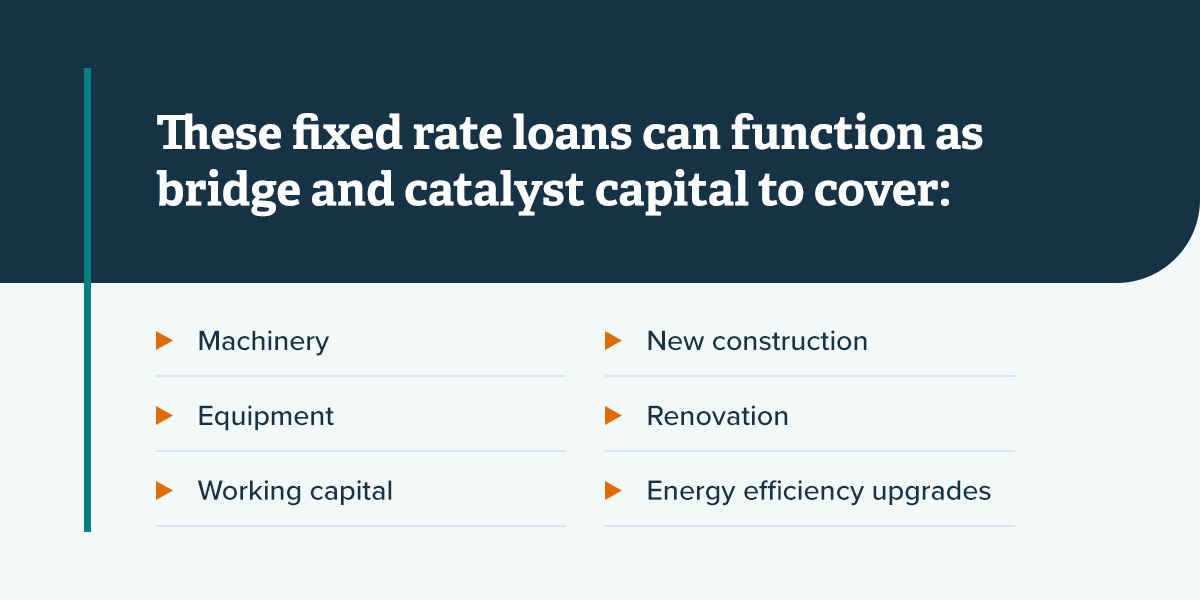
For manufacturers coordinating multiple funding sources, CAEDC’s Cumberland Capital + Connection Loans can fill the timing gap between when you need capital and when larger state programs can activate. These fixed rate loans can function as bridge and catalyst capital to cover:
- Machinery
- Equipment
- Working capital
- New construction
- Renovation
- Energy efficiency upgrades
Supporting Services
From grant facilitation and site selection assistance to workforce development connections and tax abatement structuring, our range of services supports Cumberland County manufacturers in many ways. This represents genuine one-stop coordination capability for manufacturers navigating complex capital requirements.
Operational Support
Lenders evaluate more than just your balance sheet. They assess whether your operations can deliver the growth you’re projecting, and demonstrating process efficiency strengthens that case. We also connect you to the right resources for operational improvement that support your capital strategy.
Get Layered Capital Support From CAEDC
Capital layering requires coordination, and CAEDC provides exactly that coordination for Cumberland County manufacturers. We function as the bridge between business and government, helping you navigate loan programs, grant opportunities, tax abatement structures, site selection, and workforce development connections.
CAEDC has been assisting businesses for over 20 years, so our team understands how state programs integrate with private financing and when each layer needs to activate to support your project timeline. Whether you’re planning equipment purchases, facility expansion, or operational improvements, we’re here to help.
To find out how we can help your manufacturing business gain access to the finances and tools it needs to develop a capital stack, contact us today.
