
Forged in Carlisle: The Legacy of Frog Switch
The Frog Switch plant was a cornerstone of Carlisle’s industrial identity for nearly two centuries, evolving from a local foundry to a global manganese-steel casting leader—before economic pressures halted production. Now, its legacy is transitioning into a redevelopment project aimed at revitalizing this almost 27-acre industrial site.
The Foundry’s Early Days
In 1840, Franklin Gardner founded a small foundry and machine shop at East High & Bedford Streets in Carlisle. The business produced steam engines, grain drills, and rail cars. By 1881, it became F. Gardner & Sons, and a year later, operations moved to a 13-acre site along Trindle Road.
Renamed Carlisle Manufacturing Company, the facility reached a production rate of about five railroad cars per day. In 1884, the company expanded to manufacture railroad “frogs” and switches—specialized components critical to rail infrastructure.
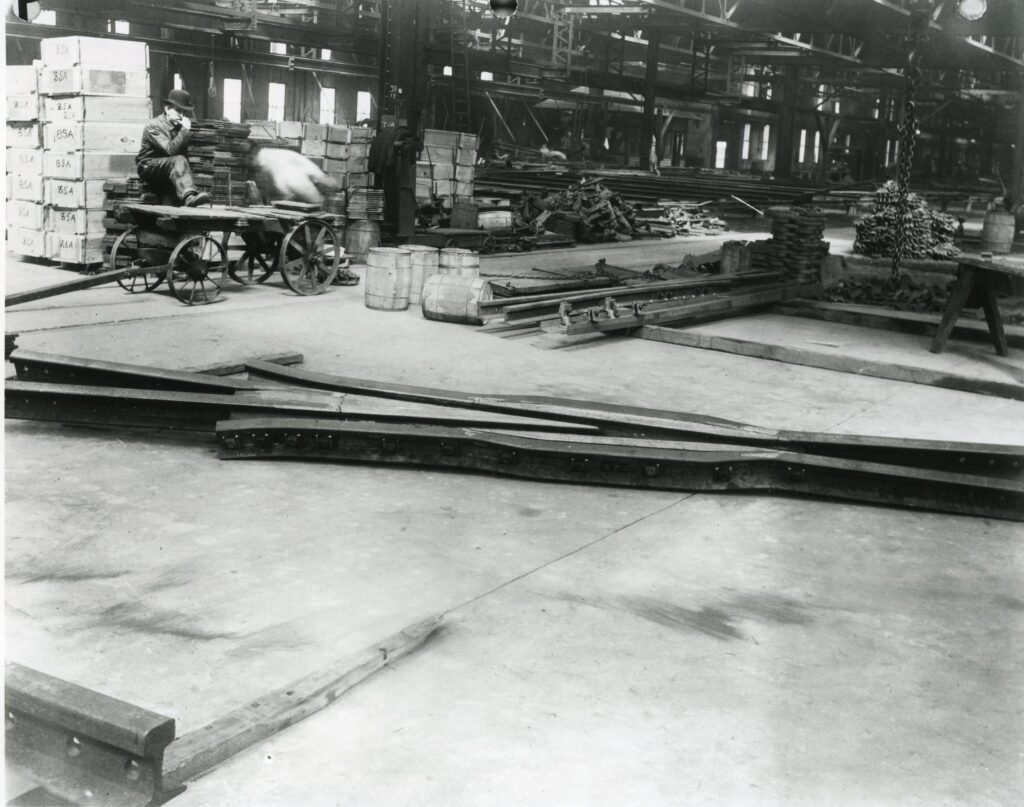
Circa 1913 (Cumberland County Historical Society photo archive)
The frog is the area where the rails of the diverging tracks cross, and the switch is the mechanism that physically moves the rails to guide the train onto the desired track. How did the “frog” get its name? A frog can be found on the underside of a horse’s hoof and is shaped like a letter V. It’s said that early railway engineers were reminded of a horse’s frog by the converging rails at a railway turnout and the name stuck.
The Founding of a New Company
A key founder of the Carlisle Manufacturing Company, John Hays and his associates formed a new entity in 1898 centered on these railroad components. Under his leadership, annual output surged from roughly 2,000 frogs and switches to between 15,000 and 18,000. The distinctive name – Frog, Switch & Manufacturing Co. – was adopted in 1907.
Resilience in Crisis
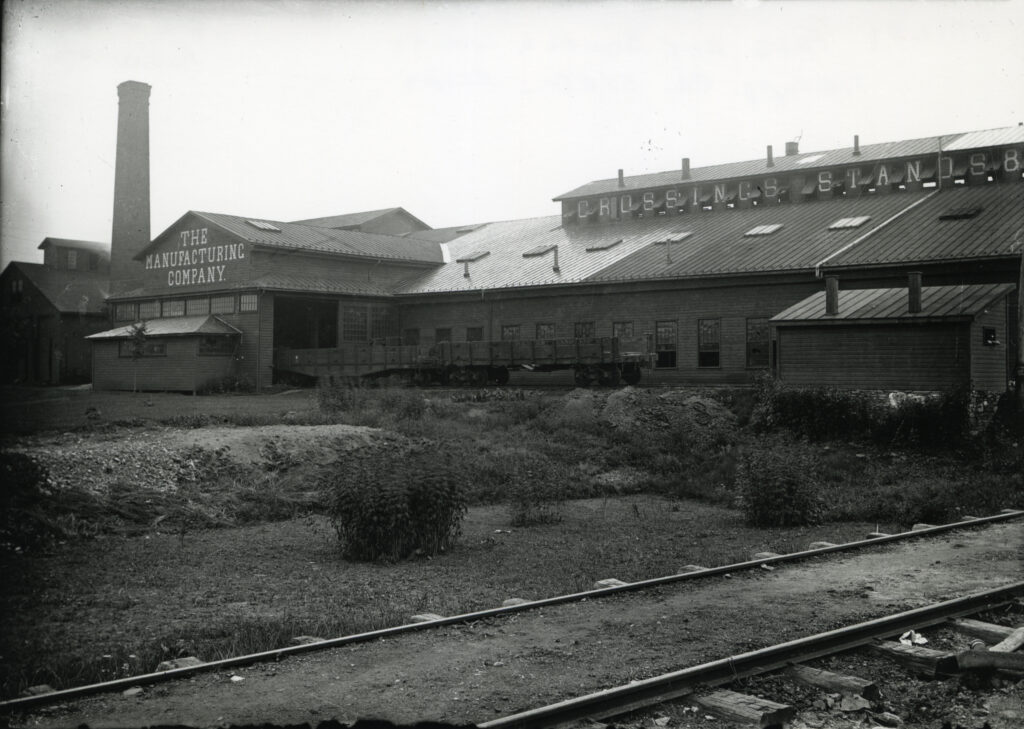
The old car shop, circa 1910, by Albert Allen Line (Cumberland County Historical Society photo archive)
A devastating fire in May 1909 destroyed much of the plant. In a remarkable act of leadership, Mr. Hays immediately launched rebuilding efforts. By 1913, the company had not only recovered, it had expanded, adding a manganese-steel foundry, diversifying production beyond frogs and switches.
The Hays Family: A Life of Service
Born in Carlisle in February 1837, John Hays graduated from Dickinson College in 1857. He studied law in Carlisle, was admitted to the bar in August 1859, and began practicing locally. During the Civil War, he was commissioned as 2nd Lieutenant of Company A, 130th Pennsylvania Volunteers. He saw combat at Antietam and Fredericksburg and was wounded at Chancellorsville. After the war, he held several prominent positions in Carlisle and was actively engaged in civic endeavors, including serving as a Presbyterian church leader and an 1880 Republican convention delegate.
Mr. Hays continued managing the company into retirement. He passed away on November 30, 1931, at the age of 84. His descendants continued the family-run industrial enterprise. Mr. Hay’s great-grandson, Raphael S. Hays II served as President and Chairman of the Board until his death in 2018. His wife, Janice Corfield Hays, sat on the company’s Board of Directors and was active in several Carlisle civic organizations. Elizabeth “Bessie” Jamieson, John Hays’ great-granddaughter, was President of the Board at the time of the plant’s closure and oversaw the transfer of the site to the Real Estate Collaborative (REC), a subsidiary real estate development company of the Cumberland Area Economic Development Corporation (CAEDC) formed in 2016 to repurpose underutilized properties throughout Cumberland County.
Bessie is a dedicated philanthropist and remains committed to preserving the legacy of her family’s business while ensuring responsible redevelopment of the company’s historic site.
Winds of Change
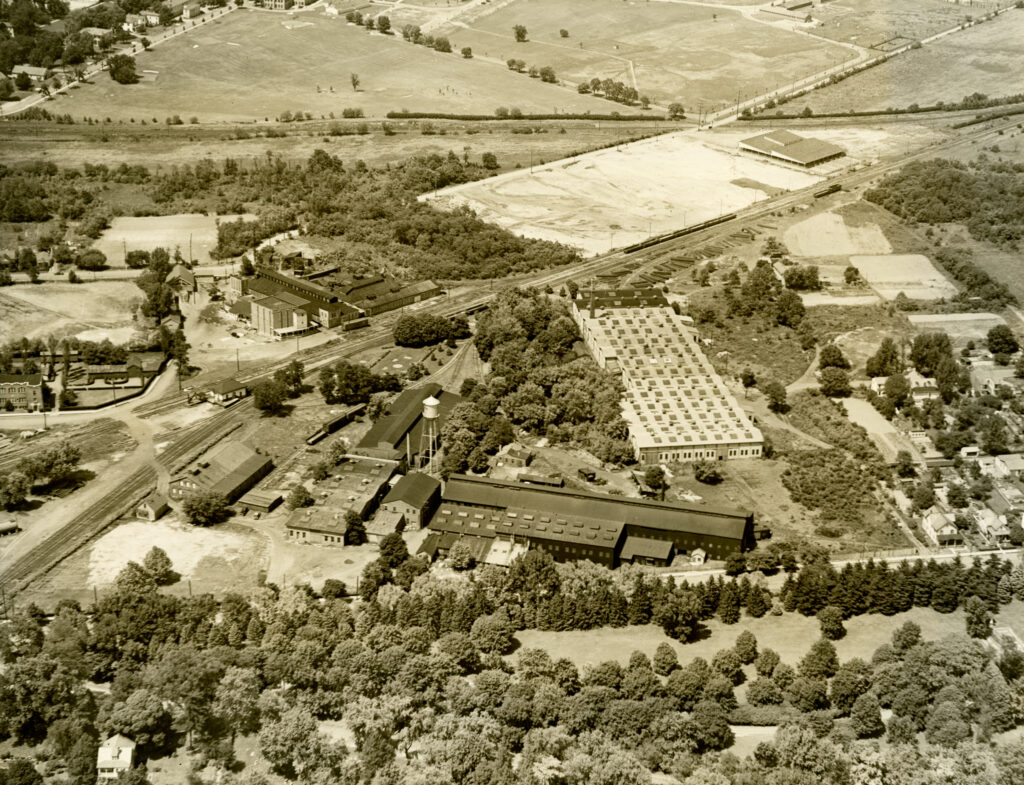
Frog Switch aerial photo, circa 1940, by S.W. Kuhnert (Cumberland County Historical Society photo archive)
At its peak, the company employed around 240 workers. By late 2014, 187 employees worked three shifts, generating $40 million in annual sales. But with global competition and mounting capital costs, the company’s board decided to cease operations. Production officially ended June 30, 2023, with about 30 employees remaining. The Cumberland County Historical Society acquired numerous company artifacts to preserve its legacy.
Shaping Carlisle for Generations
John Hays was a quintessential community leader—a war veteran, lawyer, and businessman. Mr. Hays and his descendants have played an influential role in shaping this local industry with resilience, adaptability, and dedication. Through war, fire, industrial transformation, and economic shifts, Frog Switch remained a resilient and iconic part of Carlisle’s identity. The leadership and philanthropic endeavors of the Hays family have helped shape Carlisle’s economic and social landscape for generations.
Now, as the site is prepared for new opportunities, its story continues in a different form, but its history remains a tribute to the Hays’ family legacy in the Carlisle community.
Timeline/Major Milestones
1840–1882: Gardner foundry & machine shop
1884–1907: Railroad frogs, switches, railcars
1909: Major fire and rapid rebuild
1913–2000s: Shift to manganese steel castings
2008–2023: Decline and closure
2023–2025: Site acquisition by REC and redevelopment planning
Want to learn more?
Watch a 50-minute video produced by PCN that takes viewers on a tour of the Frog, Switch & Manufacturing Co. plant.
View Now